


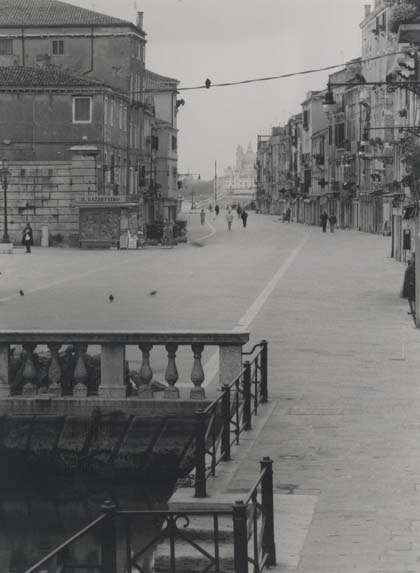
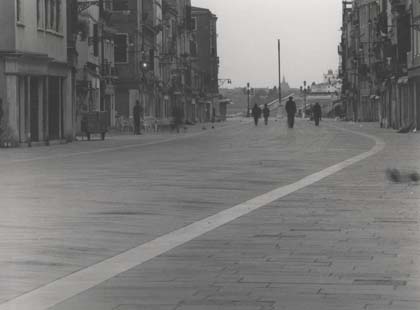
Via Garibaldi, Venezia
Project: Urban regeneration of Via Garibaldi Castello, VeniceBuilt
Location: (via Eugenia) Castello, Venice
Material: trachyte, Istria Stone
Client: Municipality of Venice
Years: 1993-1996
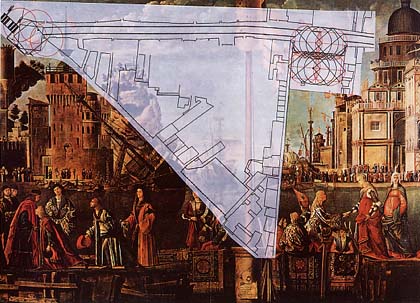
The proposal aims to recover the meaning of the intervention of the XIXth century, recovering the original tracks of via Eugenia designed by Gianantonio Selva. The project starts taking distance from previous proposals for the area of the Castlello: one for all the proposition to reopen the Rio of St. Anna -proposal difficult to understand, in respect to the physical, social and commercial potentiality of via Garibaldi. Conceptually the act of reopening this specific canal differs from the idea of the origins of Venice itself: closing or opening took place there where canals were necessary. The Rio of S. Anna has been excavated on a previous submerged promontory as “canal of urbanization” of the territory belonging to the Arsenal.
The project aims to retrieve the value and meaning of the proposal nineteenth-century renovation of track defined silting of the Rio S. Anna as the backbone of a system of infrastructure for the area east of Castle.
The “grand boulevard” connecting the S. Marco area (political and cultural hub) and Giardini (touristic and recreational area) was opposed to the idea, image and meaning behind the extension of the Riva degli Schiavoni with the construction the Riva dei Sette Martiri (1937).
In the design of Selva the great axis, 380 m long, becomes the highlight for its contribute of distribution in the system between the Arsenale and the S. Marco basin - in the bipolarity S. Marco / Giardini.
The flooring is realized by making use of materials taken from the Venetian building tradition: Istria stone for the side stripes and for the delimitation of the balustrade (demolished in the XIXth century for the construction of the shore of Sette Martiri), paving stones and salizzoni of gray trachyte placed in a precise design, which refers to the use of the materials and techniques of the late nineteenth century.

